
One of the biggest problems prediction markets had originally was trust.
Not trusting the odds or the interface. Trusting that the market would resolve correctly to match the outcome in the real world.
This is the “oracle problem” for prediction markets. And a solution eventually emerged called Optimistic Determinism. The structure for the solution is decentralized: someone proposes an outcome, and it is assumed to be correct unless challenged during a dispute window. If challenged, a resolution mechanism adjudicates, backed by economic incentives designed to reward honest reporting and penalize incorrect claims.
Today, Optimistic Determination (brokered on UMA.xyz) powers billions of dollars in prediction markets on Polymarket. It tends to be reliable but has issues. Resolution can take time. It depends on people being attentive and economically motivated at the right moment. It works best for large, high-attention markets. For smaller or more specific claims, it can be brittle and unreliable.
Agentic verification is a different approach.
Instead of centering the resolution process around proposals and dispute, it leads with agents. This isn’t a new idea (UMA and Chainlink have done interesting research) but it’s one that has been getting increasingly possible. The agents are becoming more reliable but beyond that, there are ways to structure the process around them, pairing claims with explicit verification plans, that can push the needle much further.
Earlier this week I shared a prototype for this flow.
Agentic Verification via Claim Runbook
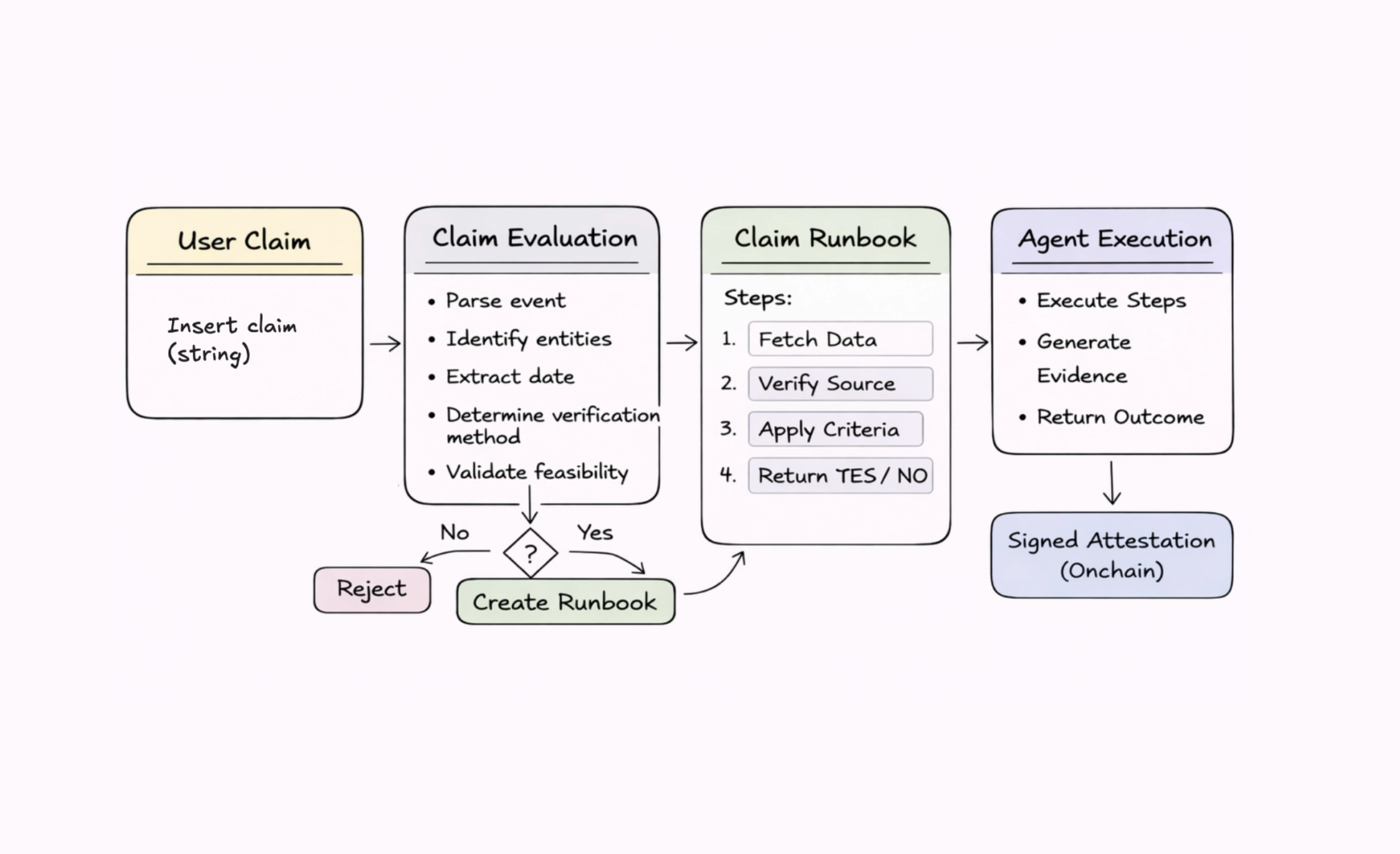
How it works.
You provide a claim and our agent disambiguates it and identifies authoritative ways to verify the claim.
If it meets required criteria, the agent creates a runbook for the claim.
Our agent executes the runbook automatically on the resolution date (or on demand) and resolves to an outcome with cited evidence.
Once resolved, the agent packages the outcome, cited evidence, and reasoning into a signed attestation onchain.
Because the attestation lives onchain, any smart contract or app can consume it instantly. (enabling prediction market resolution, conditional payments, bounties, and use cases we can’t yet imagine)
The current prototype is simple. I’m using basic models and lightweight orchestration to test the shape of the system.
But the reliability ceiling is much higher. Improving the claim runbook stage, tightening verifier inputs, or adding an optional challenge window for high-value cases all move the system toward stronger guarantees.
If that works, oracles shift from slow and coordination-heavy to fast and widely accessible. Longtail prediction markets, niche, and timebound claims, all become more viable.
It also extends beyond markets. Bounties that pay automatically. Escrow that releases without intervention. Conditional grants that trigger on measurable milestones. Trading strategies that rapidly react to verified outcomes. Any system that depends on a recorded outcome becomes easier to build.
If this direction resonates, check out the prototype.

And if you have thoughts on how to make Agentic Verification more robust, I’d love to connect. DMs are open.